The Search for Montessori Education
Many families initiate their journey into the world of education by searching for “Montessori near me” or “Montessori school near me”. This reflects a growing interest in the Montessori approach, which emphasizes holistic development and child-led learning. To assist in this search, the Montessori Maria website provides a global Montessori locator available at Montessori near me. Additionally, there are local resources, such as the example from Oberursel, Germany, found at Montessori in Oberursel, which can help families connect with local Montessori schools.
What is Montessori Pedagogy?
Montessori pedagogy is an educational philosophy developed by Dr. María Montessori. It’s rooted in the belief that children learn best in an environment that supports their innate curiosity and desire to explore. This pedagogical approach is characterized by several key principles: the prepared environment, autonomy, observation, sensory learning, and an emphasis on individualized learning paths.
The Prepared Environment
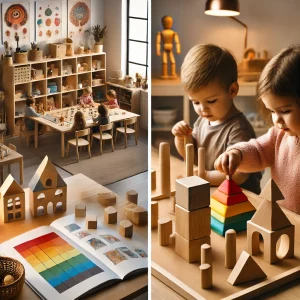
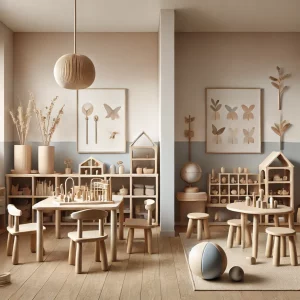
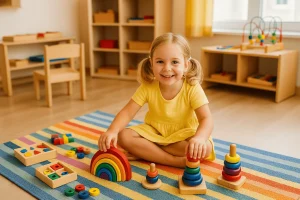
A cornerstone of Montessori pedagogy is the prepared environment. This involves creating a space that is thoughtfully organized and promotes independent exploration. In a traditional classroom, this might mean rearranging desks to form learning areas rather than rows, allowing for ease of movement and collaboration. Resources are placed at child-height so that students can access them independently. Emphasizing the prepared environment ensures children feel secure and empowered to engage with their learning materials.
Real Example: Adapting a Traditional Classroom
Imagine a first-grade classroom that traditionally uses desks in rows. By transforming this space into a Montessori-style prepared environment, the educator can introduce workstations with various activities across the room. In areas designated for sensory exploration, students might find tactile materials like sandpaper letters or practical life tools such as pouring and sorting activities. This change encourages children to interact with their surroundings in ways that are self-directed and meaningful.
Autonomy
Autonomy in Montessori education refers to the ability of children to make choices in their educational journey. This principle supports the idea that when students have a say in their learning, they are more engaged and invested. It fosters responsibility and decision-making skills. In practice, this might look like allowing students to select which activity they wish to engage in during a work period, thereby promoting self-discipline and motivation.
Real Example: Planning for Autonomy
For a student teacher preparing to implement a Montessori-inspired lesson, providing options is key. For instance, during a unit on plants, rather than assigning everyone to work on the same project, the student teacher could set up different stations: one for planting seeds, another for creating plant life cycles with art materials, and a third for researching local flora online or in books. This allows each child to choose their preferred learning experience.
Observation
Observation is a vital tool in the Montessori framework. By observing students, educators can gain insights into their interests, strengths, and areas needing support. This principle enables teachers to tailor their approaches to meet the unique needs of each child. Effective observation involves taking notes without interruption and being attentive to how children interact with materials and peers.
Real Example: The Role of Observation
Consider a classroom where the teacher notes that a child shows tremendous interest in building with blocks but struggles with collaboration. Using this information, the teacher can create opportunities for that child to work with others, perhaps by setting a block-building challenge that encourages teamwork. This approach not only supports the child’s interests but also teaches valuable social skills.
Sensory Learning
Sensory learning is integral to Montessori pedagogy. Maria Montessori recognized that children learn through their senses and that hands-on experiences are crucial for deeper understanding. This principle encompasses a wide range of activities designed to engage children’s senses in the learning process.
Real Example: Engaging the Senses
In a Montessori classroom, a sensory learning activity might involve using scented jars filled with various herbs or spices. Children can use their sense of smell to identify each item, discussing their observations with peers. This process not only enhances their vocabulary but also deepens understanding of the world around them.
Individualized Learning Paths
Montessori pedagogy emphasizes individualized learning paths, allowing students to progress at their own pace. This approach recognizes that each child is unique and learns differently. Educators create personalized learning plans that cater to the specific developmental needs and interests of each student.
Real Example: Tailoring Learning Experiences
For instance, in a math lesson, while some children might be using traditional manipulatives to grasp basic addition and subtraction, others could be engaging in more advanced problem-solving challenges. A student teacher might plan differentiated activities based on assessment observations, ensuring that every child is challenged appropriately and can work towards their personal goals.
Conclusion: Embracing Montessori Pedagogy
The principles of Montessori pedagogy provide valuable insights for parents, educators, and teacher-training students alike. By focusing on the prepared environment, autonomy, observation, sensory learning, and individualized paths, they can foster a rich and engaging learning experience. For a comprehensive understanding of this transformative approach to education, refer to our guía completa sobre la pedagogía Montessori and explore our introducción a la pedagogía Montessori for further insights. For more resources, visit our comprehensive guide. Embracing Montessori methods can pave the way for a meaningful educational journey that respects and nurtures the uniqueness of each child.