The Search for Montessori Education
Many families embark on their educational journey by Googling “Montessori near me” or “Montessori school near me.” This search often stems from a parent’s desire to provide their children with a nurturing educational environment. To assist families in finding quality Montessori programs worldwide, our website features a global Montessori locator at Montessori near me. Here, you can find schools in your area, such as those highlighted at Oberursel, Germany.
The Principles of Montessori Pedagogy
At the heart of Montessori pedagogy lies a set of essential principles designed to foster self-directed learning and holistic development in children. These principles include the prepared environment, autonomy, observation, and sensory learning. Understanding these principles is crucial for parents, educators, and teacher-training students who wish to implement Montessori methods effectively.
Prepared Environment
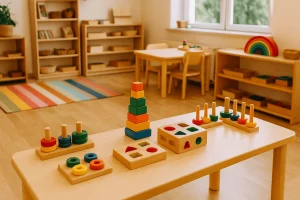
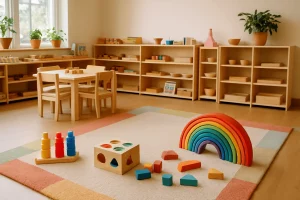
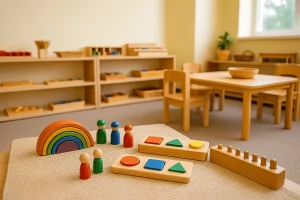
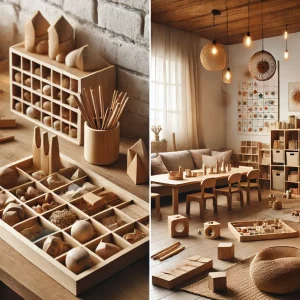
The prepared environment refers to a carefully curated space that invites exploration and learning. It is designed to engage children and provide them with developmentally appropriate materials. For instance, imagine a traditional classroom being adapted for a Montessori approach. Desks may be replaced with low shelves organized with various learning materials that children can access independently, such as books, art supplies, and practical life tools. This encourages children to take ownership of their learning and fosters independence.
Autonomy
Autonomy is a cornerstone of Montessori education. It empowers children to make choices about their learning journey, promoting confidence and self-motivation. In a practical example, think of a student teacher planning their first Montessori environment. Instead of dictating activities, the teacher provides options, allowing students to choose what they want to work on. This could be a math activity involving manipulatives or a language exercise using phonetic cards. Autonomy nurtures a love for learning and respects the child as an individual with unique interests.
Observation
Observation is an essential tool for educators in a Montessori setting. By observing children, educators gain insights into their interests, developmental stages, and social interactions. For example, an educator might notice a child who is fascinated with nature. This observation could lead to tailored activities such as a nature study project or outdoor exploration, thus creating a learning experience that is relevant and engaging for the child.
Sensory Learning
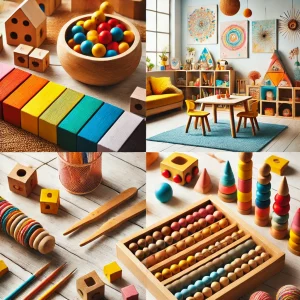
Montessori education heavily emphasizes sensory learning. Children learn best through their senses, and engaging materials that allow for tactile experiences are critical. In practical terms, a classroom might include materials such as the pink tower or the sound boxes. These hands-on tools enable children to refine their sensory perceptions while exploring mathematical concepts or sound differentiation. This experiential learning is crucial in building a solid foundation for abstract thinking.
Integrating Montessori Principles in Traditional Settings
For educators transitioning from a traditional teaching model to Montessori, it can be a transformative experience. Here are some strategies to integrate Montessori principles into a traditional setting:
Redesigning the Space
Start by examining the physical layout of the classroom. Create multifunctional areas—such as a reading nook, an art corner, and a sensory station—where students can choose to engage. Instead of rows of desks, consider clusters that promote collaboration and conversation.
Encouraging Choice and Independence
Allow students to make decisions regarding their learning tasks. Provide a menu of activities that cater to various subjects and interests. This choice empowers students and promotes engagement.
Incorporating Observation Techniques
Dedicate time each week for observation. Document student behaviors and interactions to understand their development and preferences. Use this information to guide your lesson planning.
Utilizing Hands-On Materials
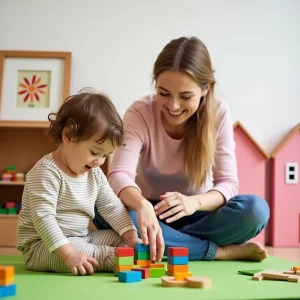
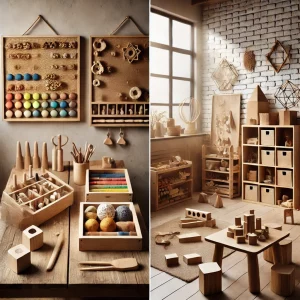
Integrate hands-on materials into the curriculum. For instance, use building blocks to teach mathematical concepts or nature items for scientific exploration. These materials invite sensory learning, which is vital in Montessori philosophy.
Resources for Further Learning
For those interested in a deeper exploration of Montessori pedagogy, I recommend checking out our complete guide to Montessori education. This comprehensive resource offers insights and suggestions suitable for parents, educators, and teacher-training students alike.
Understanding María Montessori
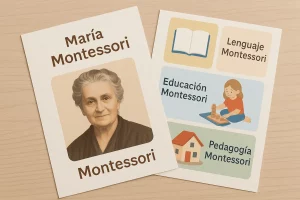
To gain a holistic perspective on Montessori pedagogy, it’s essential to understand the life and teachings of María Montessori. Her dedication to child-centered education laid the foundation for this transformative approach, providing us with strategies to nurture the whole child.
Exploring More Articles
For more insights into Montessori education, you can explore additional articles on our site, such as:
- A Comprehensive Guide to Montessori Education for Parents and Educators
- Understanding Maria Montessori: A Comprehensive Guide for Parents and Educators
- Understanding Montessori: A Practical Guide for Parents Seeking Educational Alternatives
- Montessori Pedagogy: A Comprehensive Guide for Parents, Educators, and Teacher-Training Students
- The Comprehensive Guide to Montessori Education for Parents and Educators
Conclusion
Montessori pedagogy offers a rich framework for nurturing the next generation of learners. By understanding and implementing its principles, parents, educators, and teacher-training students can create environments that promote independence, observation, sensory engagement, and a lifelong love of learning. To further explore this transformative approach or locate a school near you, visit the Montessori Maria website.