Embarking on the Montessori Journey
Many families today are looking for innovative educational approaches that cater to their children’s unique needs and learning styles. As a result, it’s quite common for parents to start their journey by searching for “Montessori near me” or “Montessori school near me.” This search often leads them to discover the transformative potential of Montessori pedagogy, founded by the esteemed physician and educator María Montessori. To help families find local Montessori environments, our website provides a global Montessori locator, accessible at https://montessorimaria.com/en/montessori-near-me, with additional local examples such as https://montessorimaria.com/en/montessori-near-me-oberursel-germany/.
Core Principles of Montessori Pedagogy
At the heart of Montessori pedagogy are several key principles that profoundly influence how children learn and engage with their environment. These principles include:
- Prepared Environment
- Auto-education
- Autonomy
- Observation
- Sensory Learning
Prepared Environment
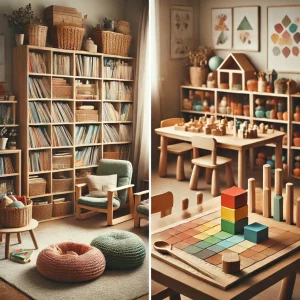
The prepared environment is a cornerstone of Montessori education. Children learn best in spaces specifically designed to facilitate exploration and learning. For example, in transforming a traditional classroom into a Montessori environment, a teacher might arrange furniture to create accessible learning stations where students can choose activities aligned with their interests. Materials are placed at child height, promoting independence as they can select resources without adult intervention. This adjustment allows children to explore freely and engage with their environment productively.
Auto-education
Auto-education, or self-directed learning, is another essential aspect of Montessori pedagogy. In this model, children are encouraged to learn at their own pace. For instance, a student teacher planning their first Montessori environment might introduce genres of books on various subjects, allowing children to gravitate toward what interests them most. This approach fosters a love for learning and helps children become lifelong learners.
Autonomy
Autonomy is crucial in Montessori settings, empowering children to make choices about their learning. A practical example of fostering autonomy in the classroom could be implementing a system where students can choose their daily tasks from a menu. Allowing children to decide which activities to engage in encourages them to take ownership of their learning experiences and instills confidence in their decision-making abilities.
Observation
Observation is a powerful tool in Montessori pedagogy, as it allows educators to understand children’s needs and interests better. For instance, as a teacher observes students during free play, they might notice a child’s fascination with building blocks. This insight can lead the teacher to introduce more advanced building materials or design engineering challenges that align with the child’s interests. Continuous observation helps educators tailor their teaching to meet students where they are developmentally.
Sensory Learning
Lastly, sensory learning is emphasized in Montessori environments, as children learn best through their senses. Materials are designed to engage touch, sight, sound, and even smell. For example, a prepared sensory corner may include textured fabrics, musical instruments, and scented plants, allowing children to explore and learn through direct experience with their environment. A practical example might include integrating smell jars with various scents for students to identify, enhancing their observational skills and sensory awareness.
Implementing Montessori Principles in Diverse Settings
Understanding Montessori pedagogy is vital not only for parents but also for educators and those in teacher-training programs. They can integrate these principles into various learning environments. For instance, teachers at a traditional school may adopt some Montessori methods, like observation and prepared environments, to enhance student learning even without a fully developed Montessori classroom.
Transforming Traditional Classrooms
Suppose a teacher wishes to incorporate Montessori principles into a traditional classroom setting. In that case, they might start by assessing their learning materials and classroom layout. The teacher could arrange desks in small groups to promote collaboration, add rich, diverse learning resources, and create spaces for individual and group work. By doing so, even a traditional classroom can mirror the dynamic, student-centered learning environment central to Montessori philosophy.
Planning for Future Educators
For student teachers preparing their first Montessori lesson plans, it’s essential to integrate active learning strategies. They can start by reviewing case studies that showcase successful Montessori classrooms and understand how the principles of the method can be applied practically. Resources such as the guía completa sobre la pedagogía Montessori provide valuable insights into creating effective learning experiences.
Further Resources and Insights
For those looking to delve deeper into Montessori pedagogy, the introducción a la pedagogía Montessori is an excellent starting point. It encompasses foundational knowledge for parents, educators, and teacher-training students alike. Always remember that the essence of Montessori is to inspire a community of enthusiastic learners, guided by their innate curiosity and passion for discovery.
Conclusion
Whether you are a parent searching for a better learning environment for your child, an educator eager to implement innovative teaching strategies, or a student teacher exploring effective pedagogy, understanding Montessori pedagogy opens doors to new possibilities in education. This method cultivates an environment of trust, respect, and intellectual curiosity, shaping future generations into autonomous and engaged learners.
Explore More
For more insights and information, visit the Montessori Maria website, where you can access resources designed to help educators and families embrace the Montessori method. Additionally, check out the latest articles, including: