Introduction to Montessori Pedagogy
Many families begin their journey into Montessori education by searching for phrases like “Montessori near me” or “Montessori school near me.” This search often leads them to the Montessori Maria website, which offers a global Montessori locator designed to help families find local Montessori schools and resources, including examples such as Montessori schools in Oberursel, Germany. The journey into Montessori education opens up a transformative world for children, parents, and educators alike.
The Principles of Montessori Pedagogy
At the heart of Montessori pedagogy are several key principles: the prepared environment, autonomy, observation, and sensory learning. Understanding these principles can greatly enhance the learning experience for children and provide educators and parents with a solid foundation for fostering independent learners.
The Prepared Environment
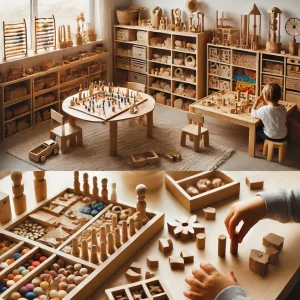
The prepared environment is a cornerstone of Montessori education. It refers to a thoughtful arrangement of a classroom space that encourages exploration, learning, and autonomy. For example, imagine a traditional classroom being adapted into a Montessori classroom. Desks can be arranged in clusters instead of rows, allowing children to collaborate and engage with one another. Shelves filled with various educational materials at children’s eye level invite them to choose activities and explore at their own pace. This prepared environment supports curiosity and active learning.
Encouraging Autonomy
Autonomy is another essential principle of Montessori pedagogy. Children in Montessori settings are encouraged to take charge of their own learning. For instance, during a free-work period, a student teacher might observe two children who express interest in gardening. Instead of providing direct instruction, the teacher facilitates by offering materials, tools, and a space for them to explore gardening concepts independently. This approach aligns with the idea of empowering children to make choices.
The Power of Observation
Observation is a vital component of Montessori pedagogy that allows educators to understand children’s needs and interests. For instance, a teacher might take time to observe how a child interacts with a new material, noting their engagement and understanding. By carefully observing, the teacher can tailor future lessons and materials to better suit the child’s individual learning style. This process underscores the significance of observation in the Montessori classroom.
Sensory Learning
Sensory learning refers to hands-on experiences that engage the senses in the learning process. In a Montessori environment, this might be exemplified through a sensory bin filled with various textures, scents, and colors. Children can explore materials freely, learning through touch and experience rather than rote memorization. Sensory learning fosters a deeper understanding of concepts, as children actively engage in their learning journeys.
Applying Montessori Principles in Teacher Training
For student teachers, understanding and applying Montessori principles is essential for creating a nurturing learning environment. Let’s explore how a student teacher might apply these principles in planning their first Montessori environment.
Setting Up the Classroom
When setting up a classroom, a student teacher should prioritize the prepared environment. They can start by arranging furniture to facilitate movement and collaboration. Instead of fixed seats, they could use low tables and rugs where students can sit on the floor or gather in groups. Additionally, equipping shelves with Montessori materials that cater to various skill levels and interests encourages children to choose their activities and explore independently.
Modeling Autonomy
Next, embracing autonomy can be accomplished by providing students with choices in their learning activities. For instance, during a unit on plants, the teacher could present a variety of options: planting seeds, drawing plant anatomy, or researching different species. By allowing students to select their preferred activity, the teacher nurtures their sense of ownership over their learning process.
Observation as a Tool for Growth
Furthermore, the student teacher should regularly practice observation. They can document students’ interests and progress over time, adjusting the learning environment and resources accordingly. This reflective practice is essential in Montessori education, as it aligns the learning environment with the evolving needs of each child.
Resources for Further Learning
To deepen your understanding of Montessori pedagogy, consider exploring additional resources available at the Montessori Maria website. Articles such as Montessori Pedagogy: A Comprehensive Guide for Parents and Educators and Understanding the Montessori Method: A Guide for Parents and Educators provide valuable insights for parents and educators alike.
Conclusion
In conclusion, Montessori pedagogy offers a unique approach to education that benefits children, parents, and educators. By embracing the principles of prepared environments, autonomy, observation, and sensory learning, we can foster a nurturing and empowering educational experience. Whether you are a parent searching for “Montessori near me,” or an educator striving to implement Montessori principles in your practice, resources and community support are readily available. Join the exploration of Montessori education, and witness the transformative impact it can have on learning.