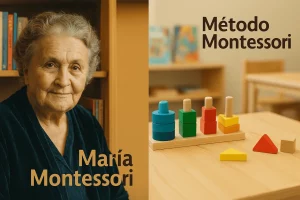
Understanding Montessori Education
Parents worldwide often find themselves typing phrases like “Montessori near me” or “Montessori school near me” into search engines as they seek suitable educational options for their children. This search behavior highlights the growing interest in alternative educational methodologies, particularly the Montessori approach. The Montessori Maria platform offers a helpful tool for local Montessori school finders, allowing parents to locate reputable programs, such as examples in Terni, Umbria – Montessori school in Terni.
Creating a Montessori Home Environment
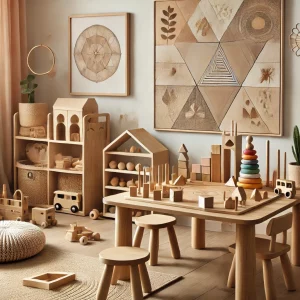
The Montessori philosophy is not confined to the classroom; it extends into the home environment, emphasizing independence and respect for a child’s natural development. Parents can create spaces that encourage learning and exploration by providing accessible resources and materials that foster autonomy.
Adapting Spaces for Independence
One effective approach is to adapt the home environment to meet the needs of the child. For example, a family might design a Montessori-inspired kitchen space where the child can assist in meal preparation. This could involve investing in child-sized tools and utensils placed within reach. A small table where the child can prepare snacks, wash vegetables, or even help set the table promotes independence and practical life skills.
Creating a Learning Zone
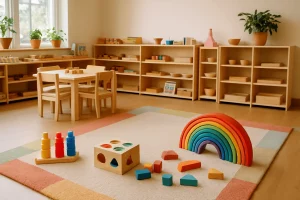
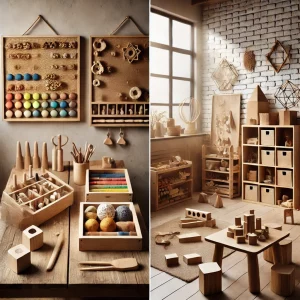
In the living area, a designated learning zone can be set up with shelves that feature a variety of educational materials. A teacher might adapt the shelf by intentionally arranging blocks, puzzles, and books that facilitate hands-on learning experiences, making it easier for children to choose their activities autonomously. It’s this allowance of choice that aligns with Montessori principles, nurturing their decision-making and concentration skills.
Exploring the Montessori School Environment
In Montessori schools, environments are carefully crafted to stimulate children’s interests and encourage self-directed exploration. The classrooms are often equipped with various materials that cater to different learning styles and developmental stages.
Hands-On Learning Materials
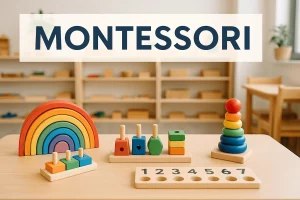
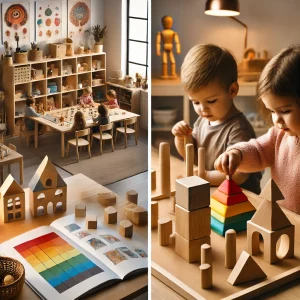
For instance, a Montessori teacher might introduce a new mathematical concept using hands-on manipulatives. Rather than relying solely on textbooks, students can physically engage with materials like counting beads or geometric shapes, providing a tactile experience that enhances their understanding. This concrete approach allows children to grasp abstract concepts more effectively, in line with an introduction to Montessori pedagogy.
Fostering Emotional Development
Emotional development is another critical component of the Montessori approach. Students learn self-regulation through carefully structured environments and guided activities. For instance, a teacher may facilitate a conflict resolution activity where children must navigate a disagreement among themselves. This method encourages the development of social skills and emotional intelligence, reinforcing the idea of respect for oneself and others.
The Role of Emotional Development in Montessori Learning
The Montessori method emphasizes the importance of emotional development alongside intellectual growth. Children learn to become aware of their feelings and the feelings of others, foster empathy, and develop resilience in the face of challenges.
Self-Regulation in the Classroom
Consider a scenario where a student is feeling frustrated with a challenging puzzle. Instead of simply stepping in to help, a Montessori educator would encourage the child to express his or her feelings and explore solutions independently. This promotes self-regulation and problem-solving skills rather than reliance on an adult for immediate answers. Providing tools for emotional expression, such as a designated quiet corner filled with calming resources, supports children in managing their emotions effectively.
Inclusivity in the Classroom
Moreover, group activities often reflect inclusivity, allowing children to work collaboratively with peers. This peer interaction fosters a sense of community and encourages them to learn from one another. A Montessori class may incorporate mixed-age groups, enabling older children to mentor younger ones, reinforcing their own knowledge while cultivating leadership skills.
Conclusion: The Benefits of Montessori Education
For parents and educators considering Montessori education, the journey begins with understanding the philosophy behind it. Montessori education offers a comprehensive approach that nurtures independence, self-regulation, and emotional development. By engaging with resources such as the complete guide on Montessori pedagogy, you can delve deeper into these transformative educational practices.
If you’re looking for support in navigating your child’s Montessori journey, the Montessori Maria platform and its AI assistant MarÍA are here to guide you through every step.
Recent Articles
To further explore the Montessorian approach, check out these recent articles:
- Understanding the Montessori Method
- Understanding Maria Montessori
- Understanding Montessori
- Understanding Montessori Pedagogy
- Understanding the Montessori Method for Parents
By embracing the principles of Montessori education, you are investing in a future where your child thrives—both academically and emotionally.