Finding Montessori Education Near You
Parents and educators around the world are increasingly turning to Montessori education as a transformative approach for developing children’s independence, creativity, and self-esteem. When searching for guidance or resources, many parents often type phrases like “Montessori near me” or “Montessori school near me” into their search engines. Fortunately, our website provides a Montessori locator tool to help you find the best Montessori programs available in your area. With the right resources, you can create an enriching environment for your child’s development.
The Home Environment
To foster a Montessori education at home, parents can create an environment that encourages independence and exploration. One excellent way to do this is by setting up a Montessori-inspired kitchen space.
Creating an Independent Kitchen Space
In a Montessori kitchen, children can have access to child-sized utensils, plates, and storage. For example, a parent might lower the countertops or provide a step stool so that the child can safely reach the sink. By allowing the child to participate in cooking and meal preparation, parents foster essential life skills and self-reliance. This practical approach helps children develop fine motor skills, understand nutrition, and instills confidence as they take on age-appropriate tasks.
Montessori Learning Shelves
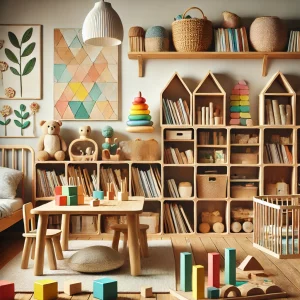
Another key element in the home environment is the use of learning shelves. A parent can adapt shelves to incorporate various materials that promote self-directed learning. For instance, consider including activities such as puzzles, sensory bins, and books. Each item should be easily reachable and organized so that children can choose what they wish to explore independently. This autonomy encourages critical thinking and problem-solving without constant adult intervention.
The School Environment
In the school environment, the principles of Montessori education shine through the connection between the prepared environment and the role of the educator. Teachers are seen as guides, facilitating children’s natural learning processes.
Adaptation of Classroom Spaces
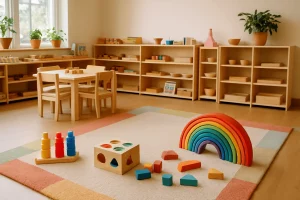
A classic example of adaptation can be seen through the arrangement of classroom spaces. For instance, a Montessori teacher might reorganize the shelves so that children can access learning materials based on their interests and developmental stages. A well-prepared environment is key to fostering independence; if a child can easily reach materials, they are more likely to engage with them.
Fostering Self-Regulation
Another fundamental aspect of the Montessori classroom is fostering self-regulation among students. For example, a teacher may implement a quiet corner with activities such as yoga mats, mindfulness exercises, or books related to emotional intelligence. This area allows students to step away when they feel overwhelmed or need a moment to regroup. In doing so, they learn to manage their emotions independently, an essential skill for their holistic development.
Emotional Development
Emotional development is a cornerstone of Montessori education, as it prepares children for real-world social interactions. Here, the interplay between home and school environments further supports their growth.
Collaboration Between Home and School
Collaboration is crucial. Parents who align their home practices with what is being taught in school create a seamless transition for their children. For instance, if teachers emphasize grace and courtesy, parents can reinforce this at home by modeling respectful communication and sharing responsibilities. Encouragement for children to talk about their feelings and share their thoughts also aids emotional development.
Building Resilience
Resilience is another vital skill developed through Montessori education. When children have the freedom to choose their activities, they also learn to navigate challenges and setbacks. A child faced with a difficult puzzle or a complex task learns valuable lessons in perseverance. An example of resilience in action is a child who, rather than turning to an adult for help, takes the time to think through the problem, explore different solutions, and ultimately feel a sense of accomplishment when solving it.
Conclusion
Montessori education provides a holistic approach to child development, emphasizing independence, emotional growth, and self-direction. By understanding the benefits of creating Montessori-inspired environments at home and in school, parents and educators can significantly enhance the learning experiences of children. For more in-depth information about Montessori pedagogy, consider exploring our guía completa sobre la pedagogía Montessori or our introducción a la pedagogía Montessori. These resources, alongside our AI assistant MarÍA, can guide you on this enlightening educational journey.
In conclusion, whether you are searching for schools or ways to implement these strategies at home, remember that the Montessori method can be an enriching path for your child’s education. The journey begins with you seeking out these resources, and our Montessori locator can help you find programs that fit your family’s needs.
Curious about the latest articles? You might find these resources beneficial: Understanding the Montessori Method, Understanding María Montessori, Discovering Montessori, Understanding Montessori Pedagogy, and Understanding Montessori Education.