Introduction
As the popularity of Montessori education continues to grow, many families embark on their search with the query “Montessori near me” or “Montessori school near me.” This indicates a desire for an educational approach that prioritizes a child’s natural development and autonomy. At the Montessori Maria website, we provide a global locator to help families find nearby Montessori schools, with local examples such as Montessori schools in Oberursel, Germany.
What is Montessori Pedagogy?
Montessori pedagogy is a child-centered educational approach developed by Dr. María Montessori. It emphasizes independence, respect for a child’s natural psychological development, and the importance of a prepared environment that encourages exploration and learning. To fully grasp the methodology, it is essential to learn its key principles, which include the prepared environment, autonomy, observation, and sensory learning.
The Prepared Environment
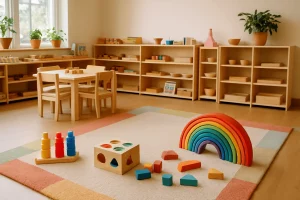
The concept of a prepared environment is crucial in Montessori education. This involves creating a learning space that is organized, inviting, and rich in materials that promote self-directed learning. For instance, consider a traditional classroom setting being transformed into a Montessori environment. Desks might be replaced with smaller tables that allow for group work, while traditional chairs are swapped for floor seating options to encourage movement and flexibility.
Practical Example
In this newly adapted classroom, shelves are stocked with diverse, age-appropriate materials ranging from sensory bins to thematic learning kits. This prepared environment invites children to engage with materials of their choice, fostering independence as they explore concepts at their own pace. Discover more about this transformative approach in our guide on understanding Montessori pedagogy.
Encouraging Autonomy
Autonomy is a foundational principle of Montessori pedagogy that empowers children to take charge of their own learning. In a Montessori setting, educators are not the primary source of information but rather facilitators who guide children in their learning journeys. This fosters confidence and self-discipline.
Practical Example
Imagine a student teacher planning their first Montessori environment. They will recognize the importance of providing choice. Instead of setting a single lesson plan for the day, they may create a variety of stations focused on different skills—math, art, reading—allowing children to choose where to focus their energy. This caters to individual interests and promotes a sense of ownership over learning.
The Role of Observation
Observation is an essential tool in Montessori education. Teachers are trained to observe students without interference, understanding their choices, interests, and needs. This practice informs future lessons and adjustments to the prepared environment.
Practical Example
For instance, if a teacher notices that several children are gravitating towards a set of animal figurines, they might introduce lessons on biology or geography related to the animals, enriching the learning experience based on the children’s natural curiosities. For more information on this, visit our comprehensive guide on María Montessori.
Sensory Learning
Sensory learning involves the use of hands-on materials that engage the senses. In a Montessori classroom, children work with a variety of tactile materials designed to reinforce abstract concepts.
Practical Example
A child learning about numbers might use tactile number rods to physically count and compare lengths, blending physical movement with cognitive learning. This type of learning caters to different learning styles while ensuring that children find joy in their educational experience. For more insights, check our article on the transformative power of Montessori education.
Benefits of Montessori Pedagogy
Montessori pedagogy offers numerous benefits, including enhanced critical thinking skills, increased creativity, and improved social skills. By fostering an environment of respect, self-reliance, and intrinsic motivation, children become lifelong learners.
Community Feedback
Parents frequently report that their children show elevated confidence levels, higher engagement in learning activities, and a lack of fear of failure as they navigate challenges. Parents interested in learning more often consult resources for parents and educators at the Montessori Maria website.
Conclusion
Montessori pedagogy provides a holistic approach to education that recognizes and nurtures the individual potential of each child. For those beginning their journey with Montessori, utilizing tools such as the Montessori school locator can be incredibly beneficial. By understanding the core principles of Montessori education, parents, educators, and teacher-training students can create enriching learning environments that respect the natural growth and development of children.
To delve deeper into the Montessori approach, consider exploring our complete guide on Montessori pedagogy. It covers everything one needs to know about implementing these transformative educational principles. Start your Montessori journey today and unlock the potential of a child-centered approach to education!