Introduction
As parents and educators navigate the vast landscape of educational methods, Montessori education stands out as a unique and effective approach. Parents across the globe frequently search for “Montessori near me” or “Montessori school near me,” eager to find guidance and resources to support their child’s education. To assist in this search, our website features a Montessori locator tool that can help you discover nearby programs, like those found at this Montessori school in Terni, Umbria.
Creating a Montessori Home Environment
Establishing a Montessori home environment is crucial for nurturing independence, curiosity, and self-regulation in children. Montessori philosophy encourages parents to modify their living spaces to foster these values. For instance, parents can create a Montessori-inspired kitchen area by placing child-sized utensils and dishware within reach, allowing toddlers to experiment with meal prep and develop necessary skills.
Independence through Preparation
Consider a family that designs a small, accessible shelf in the living room filled with books, puzzles, and art supplies. By organizing these materials thoughtfully, children can choose their activities independently, enhancing their decision-making abilities. This practice not only fosters independence but also instills a sense of responsibility and care for their belongings.
Real-Life Example: The Montessori Kitchen
In a Montessori-inspired kitchen, parents might introduce a low table where children can safely wash vegetables or help with simple cooking tasks. Such involvement allows children to engage meaningfully in daily routines, nurturing their sense of achievement and self-worth.
Montessori School Environment
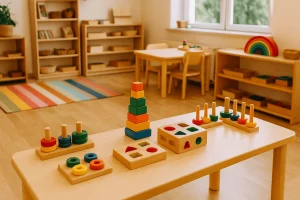
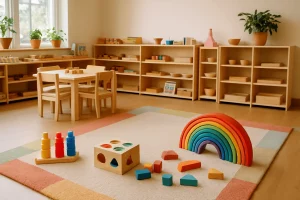
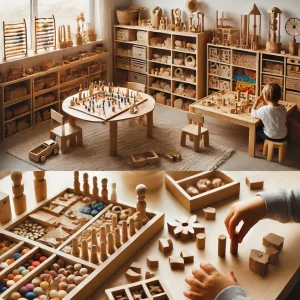
The Montessori school environment is designed to provide a unique educational experience that promotes exploration and self-directed learning. Classrooms are strategically arranged with materials accessible to children, allowing them to select their activities freely and encouraging peer collaboration.
Teacher’s Role in Adaptation
A key aspect of Montessori education is the teacher’s role as a facilitator. For instance, a teacher might observe a child struggling to reach materials on a high shelf and consequently adapt the classroom setup by moving the materials to a lower shelf. This simple act not only enhances the child’s independence but also emphasizes the importance of careful observation and response to individual needs.
Benefits of Self-Regulation
Imagine a student in a Montessori classroom who signs up for a weekly project that involves building a model of a city. As they work, they learn to manage their time, set goals, and finish tasks independently. This self-regulation is a vital outcome of Montessori education, preparing students for the academic and life challenges ahead.
Emotional Development in Montessori Education
Montessori education also places a strong emphasis on emotional development, allowing children to connect with their feelings and those of others. The nurturing, respectful environment encourages children to express their emotions and engage in conflict resolution, promoting kindness and empathy.
Building Empathy through Interaction
In a Montessori classroom, children are often encouraged to brainstorm solutions together when conflicts arise. For example, two children might negotiate over the use of a favorite toy, guided by their teacher to find a compromise. This experience helps them learn to empathize with others’ perspectives and develop social skills necessary for healthy relationships.
Supporting Emotional Awareness at Home
At home, parents can practice emotional awareness by creating a “feelings chart” where children can express how they feel each day. By discussing emotions openly, parents support their child’s emotional development, reinforcing the values learned in a Montessori environment.
Conclusion
Montessori education is a holistic approach that nurtures the intellectual, emotional, and social development of children. By integrating the principles of Montessori into both home and school environments, parents and educators can foster an atmosphere of independence, curiosity, and respect. For parents ready to explore more about Montessori, consider referring to our complete guide on the Montessori pedagogy and our introduction to the Montessori pedagogy. For more insights, our latest articles provide deeper understanding and practical strategies to implement Montessori principles effectively in your child’s education.